Uses and classification of stainless steel equal-length
Stud Bolts1. According to the force mode of
double ended bolts connection, it can be divided into ordinary and reamed holes. Ordinary bolts mainly bear axial force, and can also bear lateral force with low requirements.
stainless steel stud bolt for reamed holes should be the same size as the hole and used when subjected to lateral force.
2. According to the shape of the head: there are hexagonal heads, round heads, square heads, countersunk heads, stud bolts, etc. Among them, the hexagonal head is commonly used. Generally, the countersunk head is used in places where the surface after the connection bolt is required to be smooth and without protrusions, because the countersunk head can be screwed into the component. The round head can also be screwed into the part. The tightening force of the square head can be larger, but the size is large. 3. In addition, there are special uses: T-slot bolts, which are mostly used on machine tool fixtures, with special shapes, and the two sides of the head must be cut off. Anchor bolts are used to connect and fix machines to the ground, and there are many shapes.
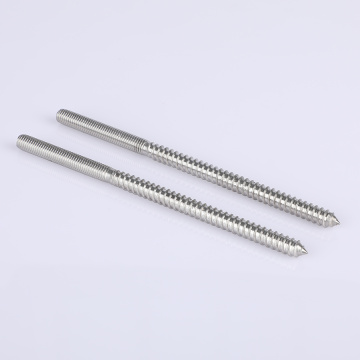
4. There are also special studs for welding for stud bolts and anchor bolts. One end has threads and the other end does not. They can be welded on the component and the nut can be screwed directly on the other side. Installation method of stud bolts
1. The installation process characteristics of stud bolts. Lubricating oil must be used when installing stud bolts. This is to prevent the bolts from getting stuck when screwed in, and to enable disassembly and repeated installation. In order to ensure the tightness of the fastening end of the stud bolt and the thread of the equipment body, the stud bolt will not loosen during the installation and removal of the nut. Therefore, the fastening end of the stud bolt should be waved to give a certain interference to the rear middle diameter. A shoulder structure can be used, or the depth of the last few turns of thread is shallow to tighten. When the stud bolt is installed in a soft material thread machine, the interference can be slightly larger.
2. The axis of the stud bolt must be perpendicular to the surface of the body. This must be noted when drilling the bottom hole and tapping. Use a square to check during installation. When the axis is slightly tilted from the surface of the body, the screw hole can be corrected with a tap, or the installed stud bolt can be used for correction. When the tilt is large, it is not allowed to use strong correction to prevent the bolt from being damaged.
3. Stud bolts are used to connect the fixed link function of the machine. Both ends of the stud bolts have threads, and the screw in the middle is thick or thin, sometimes called stud screws. Stud bolts are mainly used in mining machinery, bridges, automobiles, motorcycles, boiler steel structures, cranes, large-span steel structures and large buildings.
The production process of
stainless steel stud bolts The production of stud bolts requires fixed equipment and machine tool processing. Of course, the processing procedure is relatively simple. There are mainly the following processes: First, it is necessary to pull the material. Pulling the material is to use a puller to straighten the distorted material. After this process, the next process can be carried out. The next process is to use a cutting machine to cut the straightened long material into the length required by the customer according to the customer's requirements. This completes the second process. The third process is to put the cut short material on the thread rolling machine to roll out the thread; here the ordinary stud bolts are processed. Of course, if other requirements are required, other processes are required.




 Contact Now