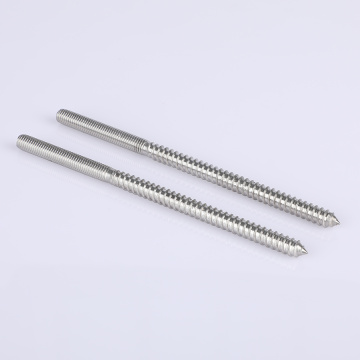

stainless steel stud bolts are round screws with threads on both ends. They are used to connect mechanical fixings. Both ends of the Stud Bolts have threads. The screw in the middle can be thick or thin. They are widely used in electric power, chemical industry, oil refining, valves, railways, bridges, steel structures, auto parts, machinery, boiler steel structures, hanging towers, large-span steel structures and large buildings. They are used when the main body is large equipment and accessories need to be installed, such as sight glasses, mechanical seal seats, reducer racks, etc. At this time, stud bolts are used. One end is screwed into the main body, and the other end is nutted after the accessories are installed. Since the accessories are often disassembled, when the main body and accessories are directly connected by bolts, the main thread will wear or damage over time, and it is very convenient to replace them with stud bolts. Studs generally need to be surface treated. There are many types of bolt surface treatments. Commonly used ones are electroplating, blackening, oxidation, phosphating, non-electrolytic zinc flake coating treatment, etc. However, electroplated fasteners account for a large proportion of the actual use of fasteners. It is especially widely used in industries and fields such as automobiles, tractors, home appliances, instruments, aerospace, and communications. However, for threaded fasteners, they are not only required to have a certain degree of corrosion resistance during use, but also to ensure the interchangeability of the threads, which can also be called screwability. In order to simultaneously meet the dual performance requirements of "corrosion resistance" and "interchangeability" of threaded fasteners during use, it is very necessary to formulate a special electroplating layer standard.
stainless steel stud bolts are strictly produced in accordance with ASTM A193B7B7MB8B8M B6B16, A320L7L7M8B B8M grades, with complete specifications and strong processing capabilities. The dimensions can be in accordance with GB897, GB898, GB899, GB900, GB901, DIN938, DIN939, IFI136, double heads according to drawings, etc. There are A-type thick rods and B-type thin rods. Optional materials:
1. AISI4140, AISI4145
2. AISI304/S30400, AISI316/S31600
3. AIS410/S41000
4. Cr-Mo-V alloy steel
Surface treatment: natural color, blackened, zinc-plated (Zn, HDZn), nickel-plated (N), cadmium-plated (CAD), Dacrotized, PTFE-coated, VFluo (fluoropolymer)-coated, etc.